Triple Crown Betting: How to Bet the Kentucky Derby, Preakness Stakes, and Belmont Stakes

Written by: Eddie Griffin
Last Update: Tue Jun 09, 2026, 11:04 pm ET
Read Time: 15 minutes
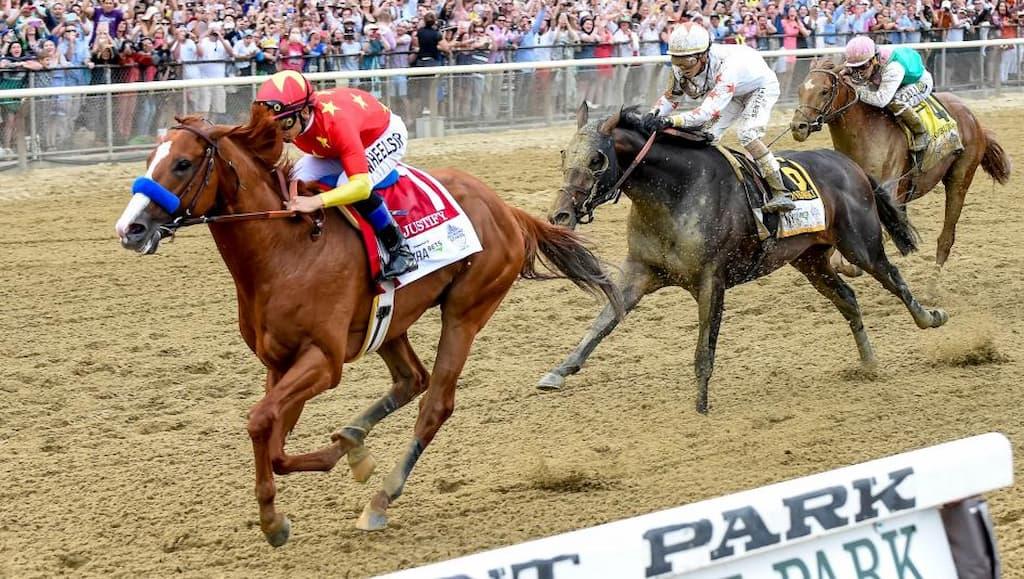
The Triple Crown of Thoroughbred Racing is one of the most recognizable and challenging stretches in sports, consisting of three major horse races run over a five-week span each spring. It begins with the Kentucky Derby, continues with the Preakness Stakes, and concludes with the Belmont Stakes.
While each race carries its own prestige, together they form a series that tests speed, stamina, and adaptability.
Similarly, from a betting standpoint, each Triple Crown race is a distinct race that requires a distinct approach. Field sizes, race dynamics, and public betting behavior shift significantly from one leg to the next, creating changing conditions that can either expose value or inflate odds.
This guide breaks down what bettors should know to approach the Triple Crown races with a structured strategy. It covers top online racebooks for Triple Crown betting, how each race differs, how wagering works in horse racing, and how to interpret both historical trends and current conditions. The goal is to provide a clear framework for making more informed betting decisions throughout the three races.
Get Picks for the Triple Crown Races from Betting News
Betting News offers expert picks and computer picks for many of the top horse races and top horse racing tracks in the United States.
Our daily horse racing computer picks include picks for all three Triple Crown races, as well as wall-to-wall coverage for each race week by Chris Adams, our horse racing expert.
For the Kentucky Derby, that means Kentucky Derby expert picks, Kentucky Oaks picks, and best bets for the other races at Churchill Downs during Derby week.
When the second leg rolls around, Chris has Preakness Stakes expert picks, Black Eyed Susan Stakes picks, and best bets for the other races during Preakness week.
Then, for the final leg of the trio, Chris will have Belmont Stakes expert picks and best bets for the New York Stakes, Resorts World Casino Manhattan, and other races during that week.
Where to Bet on Triple Crown Races
Top Racebooks for Triple Crown Betting
Choosing the right racebook is an important part of betting on Triple Crown races, particularly given how quickly odds can shift leading up to post time. Platforms like BetOnline Racebook, Everygame Racebook, SportsBetting.ag Racebook, and Bovada Racebook provide strong coverage of these races, including early futures and a full range of betting options on race day.
These racebooks are especially valuable during high-traffic events like the Derby, when betting volume spikes and odds can change rapidly in the hours and minutes before the race begins.
What to Look for in a Racebook
Triple Crown betting operates on a pari-mutuel system, meaning you are betting into a shared pool rather than locking in fixed odds. Because of this, real-time odds updates and reliable wager processing are critical, particularly close to post time when pricing is most accurate.
It is also important to use platforms that can handle heavy traffic without delays and offer a full menu of exotic wagers. During major race days, slower platforms can make it difficult to place bets efficiently, which can impact both timing and value.

What Is the Triple Crown in Horse Racing?
The Three Races Explained
The Triple Crown is a three-race series held each spring, consisting of the Kentucky Derby, Preakness Stakes, and the Belmont Stakes. These races take place across a five-week period, beginning in early May and concluding in June.
Each one tests a different aspect of a horse's ability.
The Derby, which takes place at Churchill Downs in Louisville, Kentucky, features the largest field and often the most unpredictable race conditions.
The Preakness, which typically takes place at Pimlico Race Course in Baltimore, Maryland but took place at Laurel Park in Laurel, Maryland in 2026, follows with a smaller group and a more controlled pace.
The series closes out with the Belmont Stakes, which typically takes place at Belmont Park in Elmont, New York but took place at Saratoga Race Course in Saratoga Springs, New York in 2024, 2025, and 2026. The Belmont Park track is a mile and a half, the longest distance of the three races, but Saratoga is a mile and a quarter.
Why Completing the Triple Crown Is So Difficult
Winning all three races requires more than raw ability. Horses must recover quickly between races while adapting to different distances, pace scenarios, and track conditions. The short turnaround between the Derby and Preakness, combined with the stamina test of the Belmont, creates a unique set of challenges that few horses can overcome.
This is why a Triple Crown sweep is so rare and why each race often produces a different type of winner.
What to Know About the 2026 Triple Crown Races
2026 Triple Crown Schedule
| Race | Date | Location | Distance | Winner |
| Kentucky Derby | May 2, 2026 | Churchill Downs (Louisville, Kentucky) | 1 1/4 miles | Golden Tempo |
| Preakness Stakes | May 16, 2026 | Laurel Park (Laurel, Maryland) | 1 3/16 miles | Napoleon Solo |
| Belmont Stakes | June 6, 2026 | Saratoga Race Course (Saratoga Springs, New York) | 1 1/4 miles | TBD |
2026 Triple Crown Race Results
Kentucky Derby (Winner: Golden Tempo)
| Order | Horse | Jockey | Trainer | Margin (Lengths) |
| 1 | Golden Tempo | José Ortiz | Cherie DeVaux | — |
| 2 | Renegade | Irad Ortiz Jr. | Todd Pletcher | Neck |
| 3 | Ocelli | Tyler Gaffalione | Whit Beckman | 1 |
| 4 | Chief Wallabee | Junior Alvarado | Bill Mott | 3 |
| 5 | Danon Bourbon | Atsuya Nishimura | Manabu Ikezoe | 3 |
| 6 | Incredibolt | Jaime Torres | Riley Mott | 4 |
| 7 | Commandment | Luis Saez | Brad Cox | 5 1/4 |
| 8 | Wonder Dean | Ryusei Sakai | Daisuke Takayanagi | 7 1/4 |
| 9 | So Happy | Mike Smith | Mark Glatt | 7 1/2 |
| 10 | Emerging Market | Flavien Prat | Chad Brown | 7 3/4 |
| 11 | Further Ado | John Velazquez | Brad Cox | 7 3/4 |
| 12 | Potente | Juan Hernandez | Bob Baffert | 8 1/4 |
| 13 | Six Speed | Brian Hernandez Jr. | Bhupat Seemar | 17 1/4 |
| 14 | Robusta | Cristian Torres | Doug O'Neill | 17 1/2 |
| 15 | Albus | Manny Franco | Riley Mott | 20 1/4 |
| 16 | Intrepido | Hector Berrios | Jeff Mullins | 33 1/2 |
| 17 | Litmus Test | Martin Garcia | Bob Baffert | 37 1/2 |
| 18 | Pavlovian | Edwin Maldonado | Doug O'Neill | 48 1/2 |
Preakness Stakes (Winner: Napoleon Solo)
| Order | Horse | Jockey | Trainer | Margin (Lengths) |
| 1 | Napoleon Solo | Paco Lopez | Chad Summers | — |
| 2 | Iron Honor | Flavien Prat | Chad C. Brown | 1 1/4 |
| 3 | Chip Honcho | José Ortiz | Steven M. Asmussen | 4 1/2 |
| 4 | Ocelli | Tyler Gaffalione | D. Whitworth Beckman | 7 1/4 |
| 5 | Incredibolt | Jaime Torres | Riley Mott | 7 1/2 |
| 6 | Bull by the Horns | Micah Husbands | Saffie A. Joseph Jr. | 9 3/4 |
| 7 | The Hell We Did | Luis Saez | Todd W. Fincher | 12 1/2 |
| 8 | Great White | Alex Achard | John Ennis | 13 |
| 9 | Robusta | Rafael Bejarano | Doug O'Neill | 13 1/4 |
| 10 | Taj Mahal | Sheldon Russell | Brittany T. Russell | 13 3/4 |
| 11 | Corona de Oro | John R. Velazquez | Dallas Stewart | 17 3/4 |
| 12 | Talkin | Irad Ortiz Jr. | Danny Gargan | 19 1/2 |
| 13 | Crupper | Junior Alvarado | Donnie K. Von Hemel | 21 1/4 |
| 14 | Pretty Boy Miah | Ricardo Santana Jr. | Jeremiah C. Inglehart | 43 |
Belmont Stakes (Winner: Golden Tempo)
| Order | Horse | Jockey | Trainer | Margin (Lengths) |
| 1 | Golden Tempo | José Ortiz | Cherie DeVaux | – |
| 2 | Commandment | John R. Velazquez | Brad H. Cox | 1 1/4 |
| 3 | Renegade | Irad Ortiz Jr. | Todd A. Pletcher | 5 1/4 |
| 4 | Chief Wallabee | Junior Alvarado | William I. Mott | 8 1/2 |
| 5 | Emerging Market | Flavien Prat | Chad C. Brown | 9 |
| 6 | Growth Equity | Manuel Franco | Chad C. Brown | 9 1/4 |
| 7 | Vitruvian Man | Antonio Fresu | Doug O'Neill | 11 |
| 8 | Ottinho | Dylan Davis | Chad C. Brown | 17 |
| 9 | Powershift | Luis Saez | Todd A. Pletcher | 23 3/4 |
Key Factors for Triple Crown Bettors
The structure of the Triple Crown means each race is influenced by what happens before it. The Kentucky Derby field is determined through the Road to the Derby, the prep races that provide a pathway to Derby qualification. These races, which include the Arkansas Derby, Florida Derby, and Santa Anita Derby, provide insight into Kentucky Derby favorites and pre-race form.
Following the Derby, bettors must quickly assess which horses will likely improve, regress, or struggle with the short turnaround before the Preakness.
By the time the Belmont Stakes arrives, the field often looks very different. Some horses enter fresh after skipping earlier races, while others attempt to carry form across all three legs. Understanding how these shifting dynamics affect performance is critical when evaluating each race.
How Betting on Triple Crown Races Works
Common Bet Types for Triple Crown Races
Triple Crown wagering includes both straightforward bets and more complex exotic options. Understanding how each works—and when to use them—can help bettors approach each race more effectively.
- Win: Your horse must finish first. This is the most direct bet type and is often the best option when you have a strong opinion on a single contender, particularly in more predictable races like the Preakness Stakes.
- Place: Your horse must finish first or second. This provides a lower payout than a win bet but offers added security in competitive fields, such as the Kentucky Derby.
- Show: Your horse must finish in the top three. While payouts are typically smaller, this can be a useful option for limiting risk when backing favorites or consistent runners.
- Exacta: Predict the first- and second-place finishers in exact order. This is one of the most popular exotic wagers, offering a balance between difficulty and potential return. Bettors often use boxed exactas to cover multiple combinations in volatile races.
- Trifecta: Select the top three finishers in exact order. This increases the difficulty but can produce strong payouts, particularly when large fields include long shots.
- Superfecta: Pick the top four finishers in exact order. This is one of the most challenging wagers available and is typically used in races where uncertainty creates the potential for a large payout.
In many cases, bettors combine these approaches, using simpler bets to establish a foundation while targeting higher payouts with selective exotic wagers.
Understanding Pari-Mutuel Odds
Horse racing uses a pari-mutuel system, meaning all bets go into a shared pool. After the race, payouts are calculated based on how much money was wagered on each outcome. This differs from fixed-odds betting, where prices are locked in at the time of the wager.
Because of this structure, odds in Triple Crown races continue to change up until the race begins. This reflects how money is distributed across the field.
Morning Line vs Final Odds
The morning line represents an early estimate of how the betting market may develop, but it does not determine final payouts. Closing odds are shaped by actual betting activity and often shift significantly in high-profile races.
Triple Crown events attract a large amount of public money, which can drive down the odds on popular horses. This can create value elsewhere in the field for bettors willing to look beyond the most heavily backed runners.
Strategy for Betting on Triple Crown Races
Core Betting Principles
The most important principle when betting on Triple Crown races is recognizing that each race requires a different approach. Field size, pace, and market behavior all change from one leg to the next, and those changes directly impact betting value.
- Adjust for field size and race shape: Larger fields, like in the Kentucky Derby, introduce more uncertainty and increase the chances of traffic issues or unexpected outcomes. Smaller fields, such as in the Preakness, tend to produce cleaner races that are easier to evaluate.
- Be cautious with favorites: Public money often concentrates on well-known horses, especially in high-profile races. In some instances, this can shorten odds to a point where the potential return no longer justifies the risk.
- Use exotic wagers selectively: Yes, exactas, trifectas, and superfectas can produce large payouts. However, they are difficult to hit consistently. They are most effective in races where added uncertainty creates opportunities for value.
- Evaluate each race independently: Results from one leg do not always carry over to the next. Differences in opposition, distance, pace, and recovery time can lead to very different outcomes. That makes it important to reassess the field each time.
Kentucky Derby Betting Strategy
The Kentucky Derby is defined by its large field, which can include up to 20 horses. This creates a level of unpredictability that makes it difficult for any single horse to dominate. Even top contenders can encounter traffic issues or poor positioning, which increases the likelihood of unexpected results.
Because of this, the Derby often rewards bettors who are willing to look beyond the favorite and consider a wider range of outcomes. Longshots have a better chance of hitting the board, and exotic wagers can provide strong returns when the race does not follow a straightforward script.
Preakness Stakes Betting Strategy
The Preakness Stakes features a smaller field and a more controlled race environment. This reduces randomness and places a greater emphasis on pace and positioning. That makes it easier to identify horses with favorable setups.
A key decision for bettors is how to approach the Kentucky Derby winner, provided the winner runs in the Preakness. Public support often drives the odds down, which can limit value. At the same time, horses that did not perform well in the Derby may fare better in the Preakness and can offer more attractive betting opportunities.
Belmont Stakes Betting Strategy
At its usual venue, the Belmont Stakes stands apart due to its distance, which stretches to a mile and a half. This creates a different type of race, where stamina and the ability to maintain a steady pace become more important than early speed.
Bettors should focus on horses that have shown the ability to finish strongly and handle longer distances. Horses who have ridden in only one of the first two legs warrant a closer look, as they may have an advantage over runners coming off demanding efforts in the first two legs.
Triple Crown History
The Triple Crown has been a defining part of American horse racing for more than a century, combining three prestigious races into a single, demanding series. While each race has its own history, winning all three in succession remains one of the most difficult accomplishments in all of sports.
Triple Crown Winners
As of this year's Triple Crown races, only 13 horses have successfully completed the Triple Crown. The most recent winner was Justify (ridden by Mike Smith and trained by Bob Baffert) in 2018.
Justify was the second straight Triple Crown winner to be trained by Baffert, following American Pharoah in 2015. American Pharoah's win ended a 37-year drought between wins, the longest in Triple Crown history.
The rare successes underscore just how difficult it is and how much must go right to win the Triple Crown.
| Year | Horse | Jockey | Trainer |
|---|---|---|---|
| 1919 | Sir Barton | Johnny Loftus | H. Guy Bedwell |
| 1930 | Gallant Fox | Earl Sande | James E. Fitzsimmons |
| 1935 | Omaha | Willie "Smokey" Saunders | James E. Fitzsimmons |
| 1937 | War Admiral | Charles Kurtsinger | George Conway |
| 1941 | Whirlaway | Eddie Arcaro | Ben A. Jones |
| 1943 | Count Fleet | Johnny Longden | Don Cameron |
| 1946 | Assault | Warren Mehrtens | Max Hirsch |
| 1948 | Citation | Eddie Arcaro | Horace A. "Jimmy" Jones |
| 1973 | Secretariat | Ron Turcotte | Lucien Laurin |
| 1977 | Seattle Slew | Jean Cruguet | William H. Turner Jr. |
| 1978 | Affirmed | Steve Cauthen | Laz Barrera |
| 2015 | American Pharoah | Victor Espinoza | Bob Baffert |
| 2018 | Justify | Mike Smith | Bob Baffert |
Triple Crown Near-Misses
As notable as the successes are the near-misses, where horses have won the first two races but fallen short in the Belmont.
Near-misses for horses such as Silver Charm (1997), Real Quiet (1998), and Smarty Jones (2004) were memorable heartbreaks in the gap between Affirmed and American Pharoah.
| Year | Horse | Belmont Outcome |
| 1932 | Burgoo King | Did not enter (lameness) |
| 1936 | Bold Venture | Did not enter (lameness) |
| 1944 | Pensive | 2nd place to Bounding Home |
| 1958 | Tim Tam | 2nd place to Cavan |
| 1961 | Carry Back | Faded badly, finished 7th |
| 1964 | Northern Dancer | 2nd place to Quadrangle |
| 1966 | Kauai King | 2nd place to Amberoid |
| 1968 | Forward Pass | 2nd place to Stage Door Johnny |
| 1969 | Majestic Prince | 2nd place to Arts and Letters |
| 1971 | Canonero II | 4th place, hoof issue affected performance |
| 1979 | Spectacular Bid | 3rd place, wide trip/alleged pre-race injury |
| 1981 | Pleasant Colony | 3rd place, weakened in stretch run |
| 1987 | Alysheba | 4th place, beaten by Bet Twice |
| 1989 | Sunday Silence | 2nd place, 8 lengths behind Easy Goer |
| 1997 | Silver Charm | 2nd place to Touch Gold |
| 1998 | Real Quiet | 2nd place to Victory Gallop (nose) |
| 1999 | Charismatic | 3rd place, pulled up injured after finish |
| 2002 | War Emblem | Stumbled at start, finished 8th |
| 2003 | Funny Cide | Faded late, finished 3rd |
| 2004 | Smarty Jones | 2nd place to Birdstone |
| 2008 | Big Brown | DNF (pulled up late) |
| 2012 | I'll Have Another | Scratched (tendon) |
| 2014 | California Chrome | Bumped at start, finished 4th |
More than two dozen horses have won the Belmont Stakes after winning either the Kentucky Derby or Preakness Stakes, most recently in 2026. This year, Golden Tempo won the Kentucky Derby and Belmont Stakes but did not run in the Preakness as his team opted to rest him for the race at Laurel Park.
Conclusion
The Triple Crown is best approached as three distinct betting opportunities rather than a single continuous event. Each race introduces new variables, and those changes require bettors to adjust their strategy accordingly.
By staying aware of how race conditions evolve and how the betting market reacts—particularly in high-profile events like the Kentucky Derby—bettors can identify value that may not be immediately obvious. Discipline, flexibility, and a willingness to reassess each race are essential for long-term success.